
Venus Victrix of Capua – Sculpture in La Serena


Work
Venus Victrix of Capua
Author
Unknown
Year
20th Century [Estimated]

Work narrative
History
The Venus of Capua is a Roman sculpture from the 2nd century AD, inspired by classical Greek art.
It represents Venus, goddess of love, beauty, and mother of Aeneas, founder of Rome.
Mythologically linked to passion and fertility, it also symbolizes victory and had relationships with Mars, god of war.
Discovered in Capua, Italy, and exhibited at the Archaeological Museum of Naples, it is famous for its elegant and sensual posture.
Originally held a helmet, reinforcing its connection with victory.
This work reflects the Hellenistic influence in Rome and the classical ideal of timeless beauty.
It can also be associated with "Venus Victrix", which is its symbolic representation as a victorious goddess, although it is not a proper name of the sculpture itself, but rather a title related to its iconography.
Work record
Technical Data
AUTHOR
Unknown
CHRONOLOGY
20th Century [Estimated]
MATERIALITY
White Carrara marble.
TECHNIQUE
Marble carving
MOVEMENT
Hellenistic Greek Art

WORK DESCRIPTION
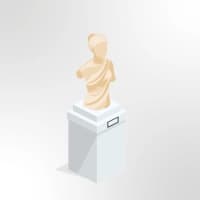
Female figure that combines serenity and dynamism in its classical posture, with one leg relaxed and the other bearing weight, creating a subtle movement in the hip.
Her serene and distant expression reflects an idealized beauty, evoking calm and divine perfection.
The fluid drapery of her clothing accentuates precise anatomical contours, while one arm holds a garment and the other points upward, adding elegance and balance between the divine and the human.